

What Determines Veeva CRM Migration Cost and Timeline?
What drives Veeva CRM migration cost and timeline: countries, users, data, customizations, integrations, validation and rollout strategy—and how to estimate defensibly.
What drives Veeva CRM migration cost and timeline: countries, users, data, customizations, integrations, validation and rollout strategy—and how to estimate defensibly.

Plan the Veeva CRM transition: platform, data, AI, integration, operating model and total-cost decisions to make well before the support deadline.
Inventory, classify and test Veeva CRM integrations—keep, remap, modernize, consolidate or retire—when moving to Salesforce Life Sciences Cloud.

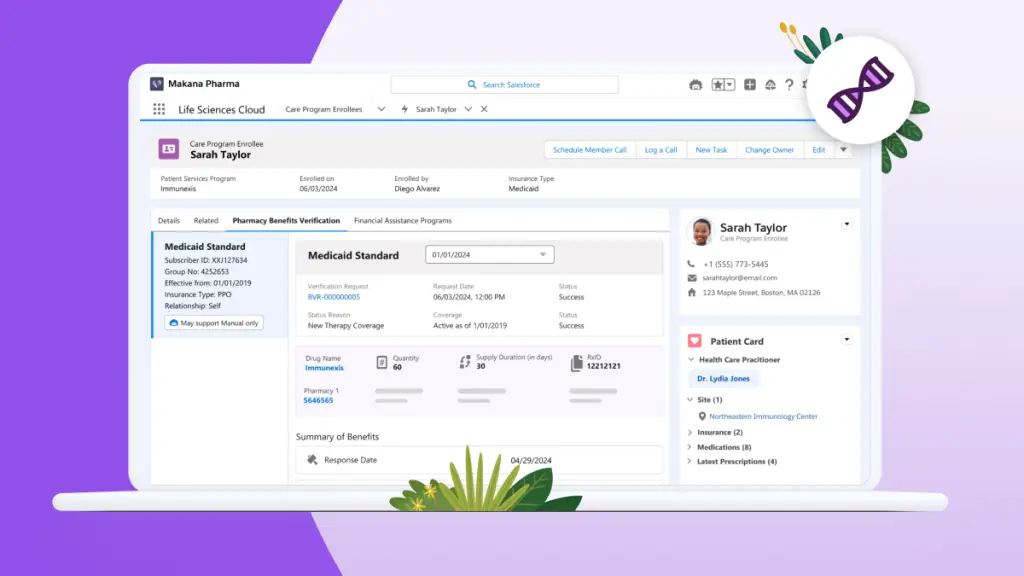
How to migrate Veeva CRM data to Salesforce Life Sciences Cloud: inventory, source-to-target mapping, cleansing, historical strategy, rehearsals and reconciliation.
Compare Veeva Vault CRM and Salesforce Life Sciences Cloud across platform, data, AI, integration, customization, analytics and total cost to choose your future Life Sciences CRM.
A practical Veeva CRM migration checklist covering environment, data, metadata, integrations, processes, compliance, testing and cutover for Salesforce Life Sciences Cloud.
Salesforce Data Cloud CDP: 2026 Expert Guide Salesforce Data Cloud CDP vs Segment CDP is a key decision for growing SMBs — Data Cloud is native to Salesforce while Segment offers broader multi-platform data orchestration. For official documentation, visit Salesforce Data Cloud. Salesforce Data Cloud vs Segment CDP for SMBs in 2026 Two leading customer data platforms compared for SMBs in 2026 — on integration depth, AI capabilities, pricing, and which delivers better ROI for businesses already on Salesforce. Get a CDP Platform Recommendation The CDP Market in 2026 Customer data platforms have become a core part of the SMB marketing stack in 2026. Two platforms come up most frequently for Salesforce-using SMBs: Salesforce Data Cloud (the native Salesforce CDP) and Segment (by Twilio, the most-used standalone CDP). Both unify customer data across sources — but they have fundamentally different architectures, pricing models, and integration depth with Salesforce. For more information, visit the official Salesforce Data Cloud page. Dimension Salesforce Data Cloud Twilio Segment Primary Architecture Native Salesforce platform — zero integration required Best-of-breed CDP — integrates via API Salesforce Integration Native — reads/writes CRM objects directly Third-party connector — requires development setup AI Integration Native — feeds Einstein and Agentforce directly Requires separate AI platform connection Identity Resolution Built-in — matches across all connected sources Built-in — strong, particularly for web/mobile data Activation Channels Salesforce clouds (MCE, AC, Service) + external APIs 350+ native destinations — very broad Real-Time Streaming Yes — real-time event streaming in 2026 Yes — core strength since launch Data Volume Pricing Consumption-based — data rows processed Consumption-based — MTUs (monthly tracked users) 2026 Starting Price (SMB) Included in Enterprise allotment + overages $120/month (Team) — scales with user volume Developer Requirement Low — configured in Salesforce UI Moderate — best with developer for full implementation Where Salesforce Data Cloud Wins for SMBs Already on Salesforce For SMBs whose core business runs on Salesforce CRM, Data Cloud has a decisive advantage: zero integration work. Data Cloud reads and writes Salesforce objects natively, feeds enriched customer profiles directly to Einstein AI and Agentforce, and surfaces insights on CRM records without any data engineering. The ecosystem coherence reduces total implementation cost and ongoing maintenance significantly compared to integrating a third-party CDP with Salesforce. Where Segment Wins Segment is the better choice when: your data stack includes many non-Salesforce systems that need real-time event streaming (web, mobile apps, product analytics), your marketing technology stack spans multiple platforms outside Salesforce (Braze, Amplitude, Mixpanel), you have a developer team comfortable with JavaScript tracking and API-first tooling, or you need 350+ pre-built destination connectors that go far beyond the Salesforce ecosystem. Segment is particularly strong for product-led growth companies that generate high volumes of product usage events. The Salesforce-First SMB Decision For SMBs whose primary operational platform is Salesforce, Data Cloud almost always delivers faster ROI than Segment in 2026. The native integration eliminates months of development work, the AI ecosystem connection is immediate, and the total cost is lower when factoring in the development and maintenance overhead that Segment requires. Segment makes more sense when your data stack is genuinely multi-platform and you need a platform-neutral CDP at the center. Can You Use Both? Some SMBs use Segment to collect and stream web and mobile event data, then pipe that data into Salesforce Data Cloud for unification with CRM data. This architecture gives you Segment’s event collection strengths and Data Cloud’s Salesforce AI integration. It is more complex to maintain but can make sense for product-led B2B companies with significant product usage data. Read our full Salesforce Data Cloud guide for SMBs. Frequently Asked Questions Is Salesforce Data Cloud replacing the need for a third-party CDP for most SMBs? For SMBs whose customer journeys happen primarily within the Salesforce ecosystem (CRM, Marketing Cloud, Service Cloud), yes. Data Cloud eliminates the need for a standalone CDP for most common use cases. Segment remains compelling for multi-platform stacks. How does Segment pricing compare to Data Cloud for an SMB with 50,000 customers? Segment Team plan starts at $120/month but scales with monthly tracked users — 50,000 MTUs would run approximately $500-$1,000/month. Data Cloud at 50,000 profiles is likely within the included Enterprise allotment at no additional cost. Data Cloud is typically cheaper for SMBs already on Enterprise. Does Segment integrate better with non-Salesforce marketing tools? Yes. Segment’s 350+ destination connectors include Google Analytics, Facebook Ads, Braze, Intercom, Mixpanel, and dozens of other tools. Data Cloud activates natively to Salesforce products and has external activation options but a smaller destination library. We are a product-led growth company with heavy product usage data. Which is better? Segment was built for this use case and handles product event streams extremely well. For PLG companies with complex product usage data feeding growth workflows, Segment is often the better CDP foundation — with Data Cloud potentially added later for the Salesforce CRM unification layer. Not Sure Which CDP Is Right for Your SMB? Cendance evaluates your data stack, marketing technology, and AI goals to recommend the right CDP approach — Data Cloud, Segment, or a combination. Free data strategy session available. Schedule a Free Consultation
Salesforce vs Microsoft Dynamics: 2026 Expert Guide The Salesforce vs Microsoft Dynamics 365 comparison for SMBs highlights Salesforce’s larger app ecosystem and stronger AI capabilities versus Dynamics’ deep Office 365 integration. For official documentation, visit Salesforce CRM. Salesforce vs Microsoft Dynamics 365 for SMBs in 2026 If your business runs on Microsoft 365, you may already have Dynamics 365 available — but is it better than Salesforce? Here is the honest 2026 comparison for SMBs. Get a Platform Comparison for Your SMB Why This Comparison Matters in 2026 Microsoft has made Dynamics 365 significantly more competitive in 2026, with Copilot AI agents built natively into the CRM and tight Microsoft 365 integration that is genuinely compelling for businesses already on Teams, Outlook, and SharePoint. For SMBs evaluating CRMs in 2026, the Microsoft ecosystem argument is stronger than it has ever been. But Salesforce retains meaningful advantages in AI agent maturity, ecosystem depth, and customization. For more information, visit the official Salesforce CRM page. Dimension Salesforce Microsoft Dynamics 365 AI Agents (2026) Agentforce — mature, production-ready Copilot in Dynamics — improved, still maturing Microsoft 365 Integration Good (connector-based) Native — seamless Teams, Outlook, SharePoint CRM Customization Extremely high ceiling High — but more complex for advanced use cases Partner Ecosystem Largest in the industry (Salesforce AppExchange) Large and growing — Microsoft partner network Marketing Automation Account Engagement, MCE (best-in-class) Dynamics 365 Marketing — competitive but less mature Ease of Implementation Requires skilled admin or partner Also complex — often underestimated Total Cost (SMB) $165-$330/user/month $65-$115/user/month for Sales apps Support and Training Extensive Trailhead self-serve learning Microsoft Learn — comprehensive documentation The Microsoft Ecosystem Advantage If your SMB runs heavily on Microsoft 365 — Teams for communication, Outlook for email, SharePoint for documents — Dynamics 365 integrates more natively than Salesforce can. Copilot AI in Teams surfaces Dynamics 365 CRM data directly in meeting cards and email threads without switching applications. For teams that live in Microsoft’s ecosystem, this workflow integration is a genuine daily-use advantage that should not be underestimated. Where Salesforce Holds the Advantage Salesforce retains clear advantages in 2026 for: AI agent maturity (Agentforce deployments are more proven at scale than Dynamics 365 Copilot agents), marketing automation depth (Account Engagement and Marketing Cloud are still ahead of Dynamics 365 Marketing for SMB use cases), AppExchange ecosystem (over 7,000 third-party apps vs. Microsoft AppSource which is catching up), and implementation partner quality and availability for SMBs. Total Cost of Ownership: The Microsoft Advantage Dynamics 365 Sales Professional starts at $65/user/month versus Salesforce Enterprise at $165/user/month — a significant difference for cost-conscious SMBs. However, the total cost picture is more complex: Dynamics 365 implementations are frequently as expensive as Salesforce ones (the software cost savings are often offset by longer customization timelines), and the Microsoft partner ecosystem for SMB-specific implementations is less developed than Salesforce’s. Evaluate total 3-year cost, not just license price. Read our guide on true Salesforce AI costs for SMBs. Who Should Choose Each Platform Choose Salesforce if: your team does not already depend on Microsoft 365 for daily work, you need best-in-class AI agents (Agentforce), you require deep marketing automation with Account Engagement or MCE, or you anticipate growing into enterprise-scale CRM requirements. Choose Dynamics 365 if: your entire business already runs on Microsoft 365 and the native integration would eliminate significant daily friction, you are highly cost-sensitive on license fees, or you already have strong Microsoft IT support in-house. Frequently Asked Questions Is Dynamics 365 free with Microsoft 365 Business Premium? No. Dynamics 365 Sales is a separate product with separate licensing. Some limited CRM functionality is available through Microsoft 365 Business Premium but not the full Dynamics 365 Sales application. How does Dynamics 365 Copilot compare to Salesforce Agentforce? As of 2026, both platforms offer AI agents. Agentforce is more mature for customer-facing autonomous use cases (lead qualification, tier-1 support). Copilot in Dynamics is stronger for internal productivity use cases that span Microsoft 365 workflows. Salesforce has a head start in production deployments. What is the typical migration cost from Dynamics 365 to Salesforce? Migrations between major CRM platforms typically cost $20,000-$60,000 depending on data volume, customization complexity, and integration scope. Account for 3-6 months of parallel running during transition. Factor this into your 3-year platform cost comparison. Do both platforms support integration with ERP systems? Yes. Both Salesforce and Dynamics 365 offer connectors to major ERP systems (SAP, Oracle, NetSuite). Dynamics 365 integrates particularly smoothly with Microsoft Dynamics 365 Finance and Operations if you are on the Microsoft ERP stack. Not Sure Whether to Choose Salesforce or Dynamics 365? Cendance provides honest platform assessments for SMBs evaluating both options. We have implemented both — our recommendation is based on your specific situation, not platform preference. Schedule a Free Consultation
Salesforce vs HubSpot CRM: 2026 Expert Guide The Salesforce vs HubSpot CRM debate for B2B SMBs in 2026 comes down to Salesforce’s superior AI depth and customization versus HubSpot’s faster setup and lower entry cost. For official documentation, visit Salesforce CRM. Salesforce vs HubSpot for B2B SMBs: The 2026 Decision Guide The two most popular CRMs for B2B SMBs in 2026 — compared honestly on AI, pricing, ease of use, and long-term scalability so you can make the right choice. Get an Expert CRM Recommendation The Honest Overview Salesforce and HubSpot are both excellent CRMs for B2B SMBs in 2026 — and choosing between them is genuinely difficult because both have invested heavily in AI, usability, and SMB-friendly packaging. The right choice depends on where you are today and where you plan to be in 3-5 years. This comparison covers the dimensions that matter most for SMBs making this decision. For more information, visit the official Salesforce CRM page. Dimension Salesforce (Enterprise) HubSpot (Sales Hub Pro/Enterprise) AI Capabilities Einstein AI + Agentforce — market-leading autonomous agents HubSpot AI — strong generative features, improving agents Autonomous Agents Agentforce — fully production-ready in 2026 HubSpot AI Agents — launched 2024, maturing Customization Extremely high — virtually unlimited with dev resources High — but bounded by HubSpot data model Ease of Use Moderate — powerful but complex High — known for clean UX and fast time-to-value Marketing Automation Account Engagement (Pardot) — powerful B2B nurturing HubSpot Marketing Hub — tightly integrated, easy to use CRM Data Model Flexible — any object, field, relationship you need Opinionated — works well within HubSpot’s framework Scalability Enterprise-grade — no ceiling Strong SMB, some limits at enterprise scale 2026 Starting Price (SMB) $165/user/month (Enterprise) $90/user/month (Sales Hub Pro) Implementation Complexity Higher — benefits from partner Moderate — more self-serve friendly Where Salesforce Wins for SMBs Salesforce wins decisively in 2026 when an SMB needs: autonomous AI agents (Agentforce is more mature and capable than HubSpot’s AI agents), extreme customization (complex sales processes, multiple business units, custom objects), deep service cloud capabilities (Service Cloud + Agentforce is still ahead of HubSpot Service Hub for complex service operations), or a clear path to enterprise scale (Salesforce has no ceiling — HubSpot customers sometimes outgrow it). Where HubSpot Wins for SMBs HubSpot wins when an SMB prioritizes: faster implementation and lower administrative overhead (HubSpot is genuinely easier to set up and maintain), tighter native marketing and CRM integration (HubSpot Marketing Hub and CRM share the same data model natively — no connector required), lower total cost at smaller team sizes (HubSpot is cheaper for teams under 15 users with standard use cases), and self-serve configuration without a Salesforce admin or partner. The Migration Question: Should You Switch? If you are already on HubSpot and considering Salesforce: evaluate the trigger. The most common migration triggers in 2026 are outgrowing HubSpot customization limits, needing Agentforce autonomous agents, or requiring Service Cloud capabilities for complex service operations. Migrations are a 3-6 month project — factor in migration costs ($15,000-$45,000 for a thorough migration) alongside license costs. See how Agentforce compares to HubSpot’s AI agents. Which Should a New SMB Choose in 2026? For an SMB starting fresh in 2026 with a B2B sales model: if AI autonomous agents are a near-term priority, choose Salesforce — Agentforce is more mature. If your primary goal is fast time-to-value and marketing-sales alignment without heavy IT involvement, HubSpot is the better starting point with a lower risk of under-utilization. Most SMBs we speak with who prioritize long-term AI capability choose Salesforce; those who prioritize simplicity and speed choose HubSpot. Frequently Asked Questions Is HubSpot less expensive than Salesforce overall in 2026? For small teams (under 10 users) with standard needs, HubSpot is typically cheaper. For larger teams or complex requirements, the difference narrows — especially when factoring in the cost of HubSpot add-ons (Service Hub, Marketing Hub, Operations Hub) that SMBs often need as they grow. Can HubSpot and Salesforce be integrated? Yes. There are native and third-party HubSpot-to-Salesforce integrations. However, most SMBs using both platforms find the integration requires ongoing maintenance and creates data synchronization challenges. Most eventually consolidate to one platform. Which platform has better reporting for SMBs? HubSpot has easier out-of-the-box reporting for non-technical users. Salesforce has more powerful custom reporting and Tableau CRM analytics for complex analysis. If your team includes a Salesforce admin or data analyst, Salesforce reporting is more capable. If you need self-serve reporting, HubSpot wins on ease. We are currently on Salesforce Essentials. Should we upgrade or move to HubSpot? Salesforce Essentials was discontinued and replaced with Salesforce Starter. If AI features are important to your roadmap, upgrading to Salesforce Professional or Enterprise is almost always better than migrating to HubSpot — you keep your data and avoid migration costs. Get an Honest CRM Recommendation for Your SMB Cendance evaluates your specific situation — sales process, team size, AI goals, and budget — and gives you an honest recommendation. We work with both platforms, so our advice is unbiased. Schedule a Free Consultation
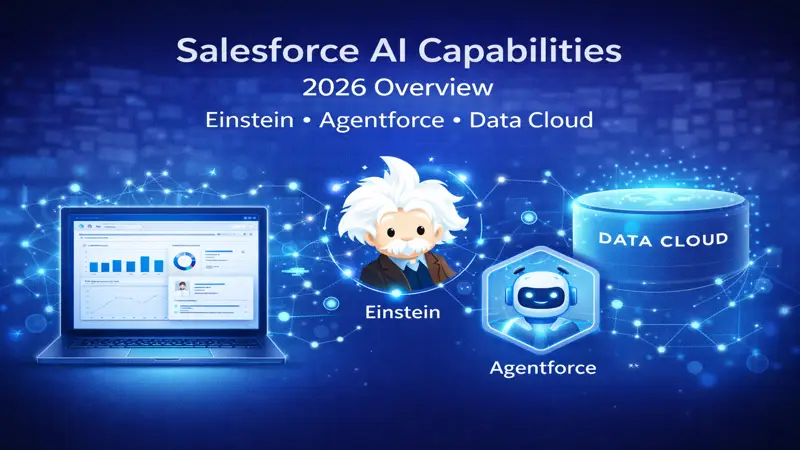
Salesforce AI capabilities 2026: 2026 Expert Guide Salesforce AI capabilities in 2026 span predictive scoring, generative content, autonomous agents, and real-time data activation — making it the most complete CRM AI stack available. For official documentation, visit Salesforce AI. Salesforce AI Capabilities 2026: The Complete SMB Overview From Einstein Lead Scoring to Agentforce autonomous agents to Data Cloud real-time profiles — here is every major Salesforce AI capability available to SMBs in 2026. See Which AI Capabilities Are Right for You Salesforce AI in 2026: A Capability Map Salesforce AI in 2026 spans four product areas — Sales Cloud, Service Cloud, Marketing Cloud, and the cross-cloud Agentforce and Data Cloud platforms. Each area has specific AI capabilities that deliver value independently and amplify each other when combined. This overview maps every major capability so SMBs can identify where to start and how to build toward the full AI stack. For more information, visit the official Salesforce AI capabilities page. Sales Cloud AI Capabilities Capability What It Does 2026 Edition Requirement Einstein Lead Scoring Ranks leads 1-99 by conversion likelihood Enterprise+ Einstein Opportunity Scoring Scores deal health, flags at-risk opportunities Enterprise+ Einstein Activity Capture Syncs emails and calendar to Salesforce automatically Enterprise+ with connected email Einstein Email Insights Flags relationships going cold based on engagement signals Enterprise+ Einstein Forecasting AI-powered revenue forecast based on historical patterns Enterprise+ Einstein Conversation Insights Analyzes call recordings for coaching signals Einstein Conversation Intelligence add-on Agentforce Sales Agent Autonomous lead qualification and meeting scheduling Enterprise+ with Einstein Platform Service Cloud AI Capabilities Capability What It Does 2026 Edition Requirement Einstein Case Classification Auto-categorizes and routes incoming cases Enterprise+ Einstein Reply Recommendations Suggests responses to common support cases Service Cloud Enterprise+ Einstein Article Recommendations Suggests knowledge articles to agents during cases Enterprise+ Einstein Next Best Action Recommends actions for service agents to take Einstein Platform add-on Agentforce Service Agent Autonomous tier-1 case resolution without human involvement Enterprise+ with Einstein Platform Marketing AI Capabilities Capability Product What It Does Einstein Send Time Optimization MCE and Account Engagement Sends emails at each individual’s optimal open time Einstein Behavior Scoring Account Engagement Scores prospects by engagement depth and buying intent Einstein Content Selection Marketing Cloud Engagement Automatically surfaces most relevant content per contact Einstein Subject Line Recommendations Marketing Cloud Engagement Tests and learns which subject lines drive opens Einstein Segmentation Data Cloud + MCE AI-generated audience segments based on behavioral patterns Cross-Cloud AI Capabilities (2026) Capability What It Does Where It Works Einstein Generative AI Drafts emails, case summaries, meeting prep, call notes Sales Cloud, Service Cloud, Slack Agentforce Studio Build and deploy autonomous AI agents Any Salesforce cloud via point-and-click Data Cloud Identity Resolution Matches customers across all data sources All clouds — feeds Einstein and Agentforce Data Cloud Calculated Insights Computes derived metrics (engagement score, LTV, churn risk) All clouds — surfaces on CRM records Einstein Copilot (now Einstein) Conversational AI assistant embedded in Salesforce UI All clouds — any Salesforce interface Which Capabilities Should SMBs Prioritize in 2026? The clearest path to AI ROI for SMBs in 2026 follows this sequence: Start with Einstein Lead Scoring and Opportunity Scoring (zero additional cost, immediate impact on sales prioritization). Add Agentforce for your highest-volume, lowest-complexity workflow. Then layer on Data Cloud enrichment and marketing AI features as your data and AI maturity grow. Every step builds on the last. See the full 12-month AI implementation roadmap. Frequently Asked Questions Are all these capabilities available on Salesforce Professional edition? No. Most Einstein AI features and all Agentforce capabilities require Enterprise or Unlimited edition, or specific add-on licenses. Salesforce Professional is designed for basic CRM functionality without advanced AI features. Which Salesforce AI capability is most searched and discussed in 2026? Agentforce is by far the most-discussed Salesforce AI capability in 2026 — it dominated Dreamforce coverage and customer conversations. However, Einstein Lead Scoring has the broadest current deployment among SMBs because it requires no additional cost to activate. Can we use Salesforce AI without a certified Salesforce admin? Basic Einstein features (Lead Scoring, Opportunity Scoring) can be activated by any user with admin access. Advanced features like Agentforce configuration and Data Cloud setup benefit significantly from certified expertise. How do Salesforce AI capabilities compare to standalone AI tools like ChatGPT? Salesforce AI capabilities are differentiated by their native access to your CRM data. ChatGPT and similar tools have no visibility into your specific leads, deals, customers, or history. Einstein and Agentforce use your actual Salesforce data to generate relevant, accurate outputs — not generic responses. Find Out Which Salesforce AI Capabilities You Should Activate Cendance conducts a free Salesforce AI readiness audit — identifying which capabilities are already available in your license, which are worth adding, and which to prioritize first. Schedule a Free Consultation