Transforming Medical Device Customer Engagement with AI Receptionists
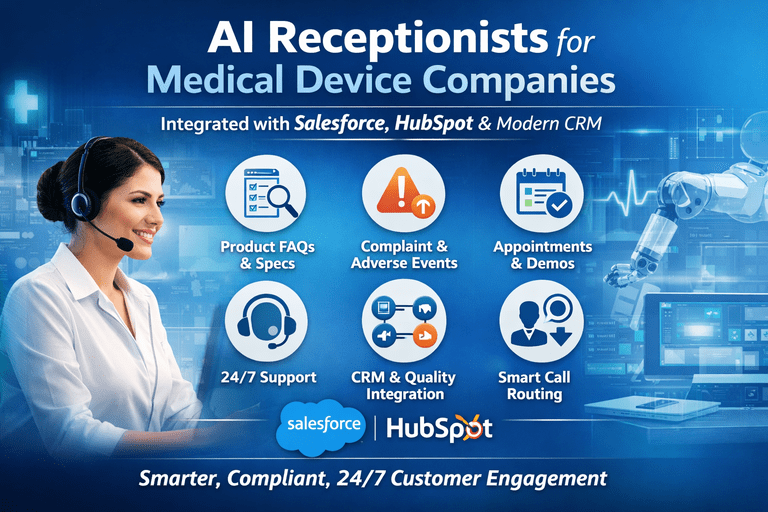
Medical device companies operate in a high-stakes environment where every call can impact patient safety, compliance, or revenue. Customers expect immediate answers, regulators expect accuracy, and internal teams need complete visibility. This is where AI Receptionists, deeply integrated with Salesforce, HubSpot, or any other CRM system, are reshaping how medical device firms manage inbound voice interactions—securely, intelligently, and at scale. Unlike traditional IVR systems, an AI receptionist becomes a smart, compliant front desk that connects voice conversations directly to CRM, quality systems, and automated email workflows. Why Medical Device Firms Are Adopting AI Receptionists Medical device organizations face unique challenges: Complex product portfolios and technical questions Strict complaint and adverse event reporting requirements Multiple stakeholders (hospitals, clinicians, distributors, patients) Fragmented systems across CRM, ERP, and Quality platforms The need for 24/7 availability AI receptionists solve these challenges by combining conversational AI with CRM intelligence, ensuring every interaction is captured, routed, and followed up correctly. Key AI Receptionist Capabilities for Medical Device Companies 1. Product Information & FAQ Support Medical device customers frequently call with questions about: Device specifications and features Usage and indications Compatibility with other systems Warranty and service coverage An AI receptionist can be trained on approved knowledge bases, product documentation, and CRM knowledge articles to deliver instant, consistent answers. CRM & Email Integration Call details are logged automatically in Salesforce, HubSpot, or another CRM Contacts and accounts are updated in real time Automated follow-up emails share datasheets, IFUs, or demo links This reduces dependency on live agents while improving response speed and consistency. 2. Complaint & Adverse Event Reporting (Compliance-Focused) Complaint intake is one of the most critical workflows in the medical device industry. AI receptionists can: Detect complaint or adverse-event intent during calls Guide users through structured, compliant questions Capture mandatory fields such as device ID, lot number, and incident description Escalate issues immediately to quality and regulatory teams CRM-Connected Compliance Complaints are created as cases in Salesforce, HubSpot, or integrated QMS platforms Data can flow to quality systems (e.g., Gridlex or other complaint management tools) Confirmation and acknowledgment emails are sent automatically This improves speed, accuracy, traceability, and audit readiness—without sacrificing compliance. 3. Appointment, Demo, and Service Scheduling Medical device firms manage a wide range of scheduled interactions: Sales demos Installations Preventive maintenance Clinical or patient follow-ups AI receptionists can: Check availability in CRM calendars Book, reschedule, or cancel appointments in real time Trigger automated email confirmations and calendar invites The result is faster scheduling, fewer missed appointments, and a better customer experience. 4. 24/7 Support with Intelligent Triage Healthcare doesn’t stop after business hours—and neither do device issues. AI receptionists provide: 24/7 call handling Intelligent triage based on urgency and intent Self-service for common questions After-hours escalation for critical situations All interactions are logged in the CRM, and summary emails ensure internal teams have full context when they follow up. 5. Seamless Integration with Salesforce, HubSpot, and Other CRMs A major advantage of AI receptionists is deep CRM integration. They can connect with: Salesforce Sales Cloud, Service Cloud, or Health Cloud HubSpot CRM, Service Hub, and Marketing Hub Other CRM or ERP platforms via APIs What this enables: Unified customer records across voice, email, and digital channels Real-time data synchronization Automated workflows and follow-ups HIPAA-conscious data handling and role-based access This ensures end-to-end visibility without creating compliance risk. 6. Smart Call Routing and Human Handoffs AI receptionists are designed to support—not replace—human experts. When calls become complex or sensitive, the AI can: Detect the need for human intervention Route calls to the right team (sales, service, clinical, quality) Pass full context, including call transcripts and CRM history Follow-up emails and CRM tasks are created automatically, ensuring continuity and accountability. The Business Impact By integrating AI receptionists with Salesforce, HubSpot, or other CRM systems, medical device firms can achieve: Faster response times Higher customer satisfaction Improved complaint and adverse event compliance Reduced operational costs Complete visibility across voice, CRM, and email channels Final Thoughts For medical device companies, AI receptionists are no longer just a call-handling tool. They are becoming a strategic engagement layer—connecting voice interactions directly to CRM intelligence, compliance workflows, and automated email communication. When integrated with Salesforce, HubSpot, or any modern CRM, AI receptionists help medical device firms scale safely, respond intelligently, and build trust in an industry where accuracy and reliability are critical. Salesforce Marketing Cloud is a game-changer for businesses that want to automate marketing, personalize customer experiences, and track results—all in one place. 🚀 Ready to see how it can work for you? Let’s chat! Book a free consultation with Cendance Inc today. FAQs Can Marketing Cloud receive emails directly? No, but it works with Service Cloud or tools like Zapier to manage them. How do I automate replies? Use Service Cloud’s Email-to-Case or Marketing Cloud’s Automation Studio for follow-ups. Is Marketing Cloud good for customer service? It’s built for marketing, but when paired with Service Cloud, you get the best of both worlds!